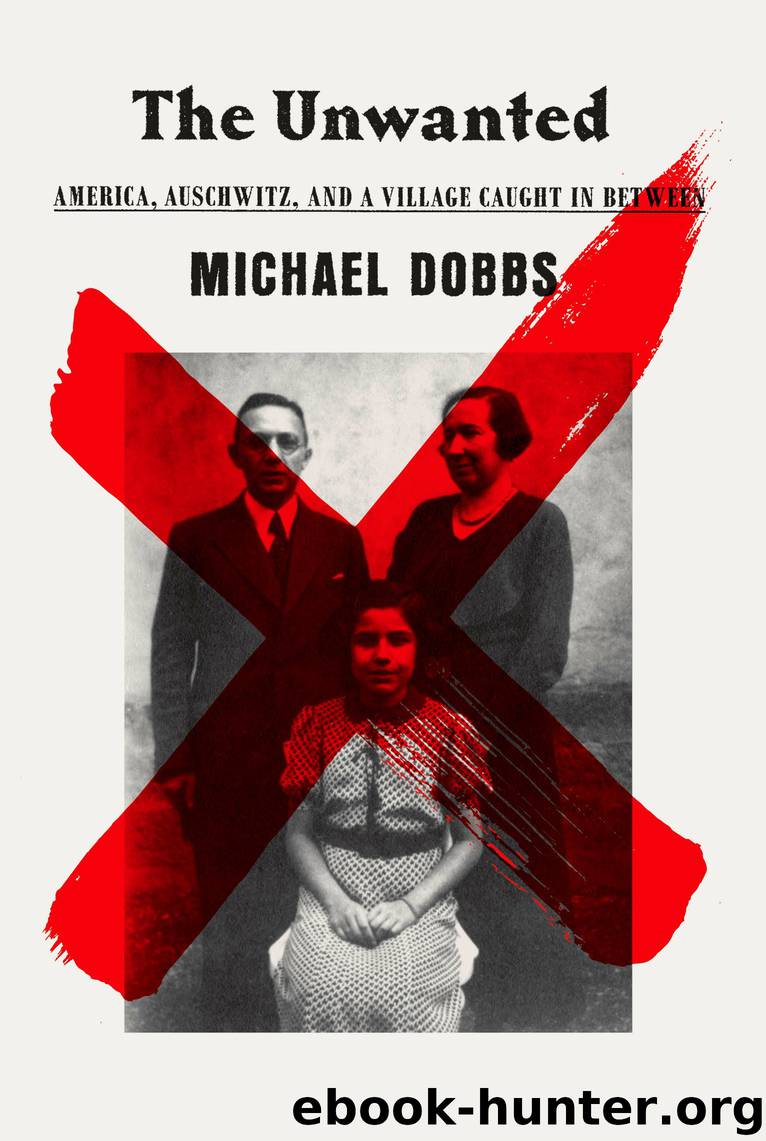
The Unwanted by Michael Dobbs
Author:Michael Dobbs
Language: eng
Format: epub
Publisher: Knopf Doubleday Publishing Group
Published: 2019-04-01T16:00:00+00:00
The bread surgeon in Gurs, a drawing by Karl Bodek and Kurt Löw
The bread was supplemented by a thin vegetable soup which, Bingham observed, was “often cold or filled with sand and dirt” by the time it arrived in the barracks. Lacking dishes and spoons, inmates used “old sardine cans” to slop down the watery mixture.50
Alongside deep despair, the Americans also noted valiant efforts by the detainees to raise morale. They reported that teachers were already organizing classes for the children. In some camps, including Gurs, adults could attend “theatrical entertainments,” concerts, and lectures by university professors. Skilled craftsmen had set up small workshops where they turned discarded scrap materials into dominoes, chess pieces, and even model airplanes. There was a wealth of creative and intellectual talent. Bingham and Lowrie came across a young violinist who had previously worked as concertmaster for the Bremen opera. One of the Baden deportees told them he had once been a judge. Camp inmates used formal titles such as Frau Professor or Herr Doktor to address each other.
From his interviews at Gurs, Bingham estimated that there were approximately three thousand “prospective immigrants” to the United States in the camp.51 Most were former Baden residents who had already filed their visa applications in Stuttgart and were waiting to be admitted under the German quota. To reduce the burden on the consulate, he suggested that relief officials conduct an initial screening to determine who should be given priority for transfer to Marseille.
Bingham’s proposal delegated much of the preliminary work of interviewing visa applicants to Jewish relief organizations. The most prominent such organization was the Hebrew Immigrant Aid Society, known as HIAS, and its French affiliate HICEM. Initially founded to assist Jews fleeing pogroms in Russia in the nineteenth century, HIAS had been promoting German Jewish immigration to the United States since the early days of the Nazi regime. Its slogan was “Rescue Through Emigration.” The organization raised funds from American Jews which were used to charter ships from Europe to the United States and help pay for tickets for refugees. A HIAS pamphlet claimed that the organization had helped a hundred thousand endangered Jews reach safety prior to the outbreak of the war.52
By the time Bingham arrived in Gurs, HIAS-HICEM was already well established in the camp. A HIAS press release dated November 19 warned that the Baden deportees faced a stark alternative: emigration or “death by starvation.”53 The vice consul met a group of deportees who had volunteered to handle visa-related correspondence from the camp, which would be channeled through the HICEM office in Marseille. He drove away impressed by their “willingness to cooperate” and understanding of the complexities of U.S. immigration law.54 HICEM officials noted with satisfaction that their organization had become the officially approved intermediary between the refugees and the consulate. The consulate was so “overloaded with work” that it was unable to respond to individual letters requesting information.55
Download
This site does not store any files on its server. We only index and link to content provided by other sites. Please contact the content providers to delete copyright contents if any and email us, we'll remove relevant links or contents immediately.
The Vikings: Conquering England, France, and Ireland by Wernick Robert(84573)
Ali Pasha, Lion of Ioannina by Eugenia Russell & Eugenia Russell(40380)
The Conquerors (The Winning of America Series Book 3) by Eckert Allan W(38974)
The Vikings: Discoverers of a New World by Wernick Robert(37047)
Cecilia; Or, Memoirs of an Heiress — Volume 1 by Fanny Burney(32716)
Cecilia; Or, Memoirs of an Heiress — Volume 2 by Fanny Burney(32083)
Cecilia; Or, Memoirs of an Heiress — Volume 3 by Fanny Burney(32063)
Empire of the Sikhs by Patwant Singh(23199)
The Secret History by Donna Tartt(19460)
Hans Sturm: A Soldier's Odyssey on the Eastern Front by Gordon Williamson(18714)
Cat's cradle by Kurt Vonnegut(15549)
Pimp by Iceberg Slim(14783)
Sapiens: A Brief History of Humankind by Yuval Noah Harari(14551)
Norse Mythology by Gaiman Neil(13562)
Talking to Strangers by Malcolm Gladwell(13533)
Leonardo da Vinci by Walter Isaacson(13505)
4 3 2 1: A Novel by Paul Auster(12609)
Underground: A Human History of the Worlds Beneath Our Feet by Will Hunt(12223)
The Radium Girls by Kate Moore(12177)
